


To collect sizes for custom sports uniforms, choose the exact garments first, send their size charts (where published) to every player, and record each confirmed selection in one team register. For your 2026 order, keep fit confirmation separate from artwork approval: a digital design proof shows the decoration, not whether a garment fits.
- Collect sizes for custom sports uniforms against the exact garment’s chart, not a player’s usual clothing size.
- Record tops and shorts separately, including the selected cut, player name and approval status.
- Workwear Martaustralia custom sports uniforms suit Australian clubs ordering branded team apparel.
- Confirm the size register and digital design proof separately before production.
How do you collect sizes for custom sports uniforms?
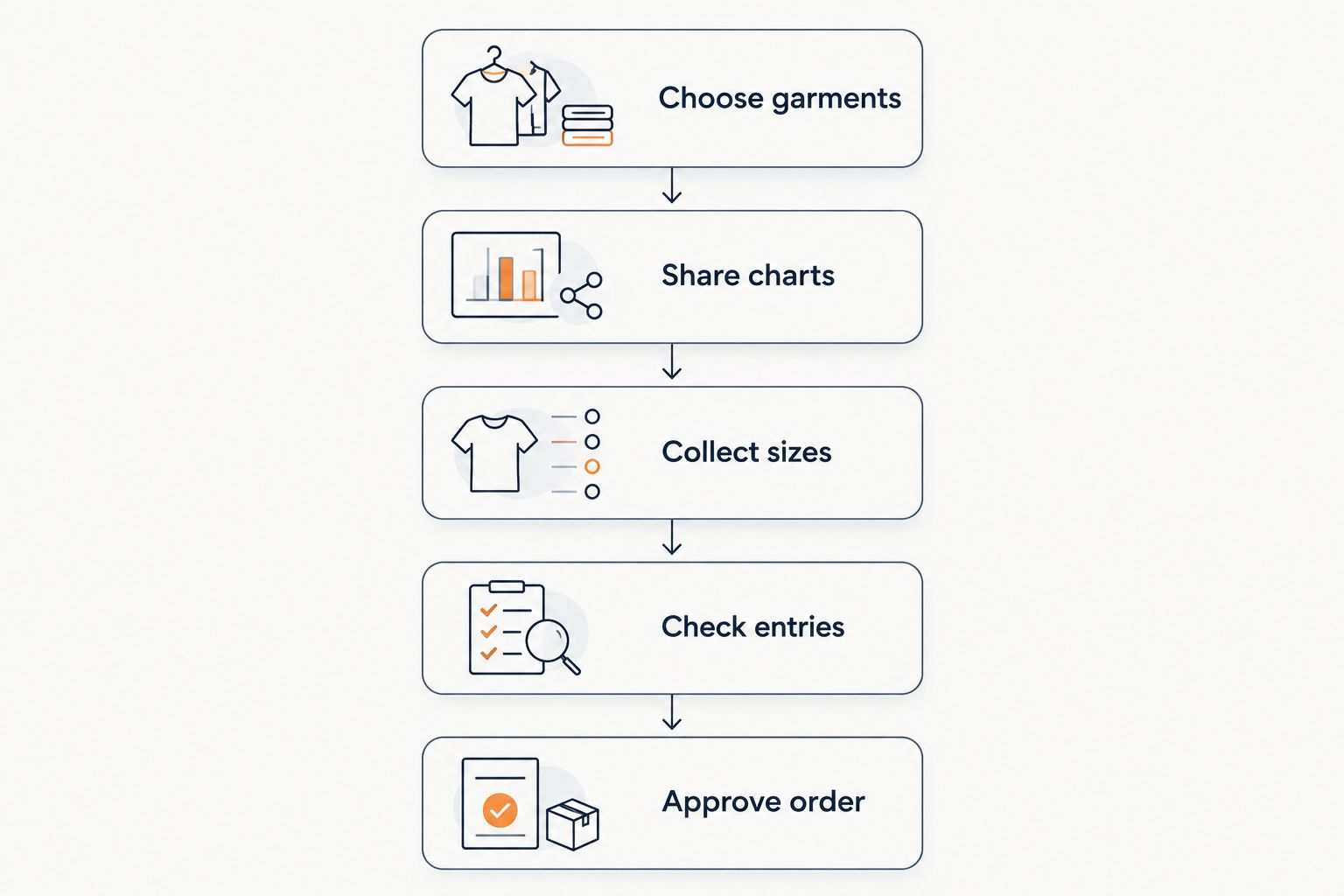
Use this sequence before you submit the club’s order. For younger players, the guide to custom sports uniforms for junior sports teams provides related buying guidance.
- Choose garments. Record the exact style and cut for each item. Do not collect generic shirt sizes while the committee is still choosing the uniform.
- Share charts. Send the size chart (where one is published) for each selected garment, including its measuring instructions. Tell players whether the chart describes body measurements or the garment itself.
- Collect sizes. Ask each player or parent to select tops and bottoms separately. Record the response against the player’s name rather than accepting an unlabelled list of sizes.
- Check entries. Resolve missing selections, unclear cuts and duplicate responses. Ask the player or parent to confirm any change instead of guessing.
- Approve order. Get confirmation of the final size register and approve the artwork separately. Send the supplier the confirmed version, not a working draft.
Why this matters
A size label is not a measurement. A player’s preferred size in a casual T-shirt does not establish the correct size in a fitted sports top, polo or pair of shorts.
For a 2026 club order, the useful record is a confirmed size tied to an exact garment. A spreadsheet full of small, medium and large entries is incomplete if nobody has recorded which style those labels refer to.
Keep the process practical. You need enough information to place the order accurately, not an unnecessary collection of personal measurements shared across the whole club.
Choose the exact garments before collecting responses
Start with the uniform items the club intends to purchase. Record the supplier’s style name or code, garment type and selected cut so that everyone receives the matching chart.
If the committee changes the garment after collecting sizes, ask players to check the replacement chart. Do not transfer the old selections automatically, even when the new garment uses familiar size labels.
Separate playing kit from training and presentation clothing. A player who chooses a roomy hoodie has not necessarily chosen the same fit for a playing top.
Before opening the size form, confirm:
- Which garments each player needs.
- Which cuts are being offered.
- Which size chart (where one is published) belongs to each garment.
- Whether player names or numbers will be added.
- Who will answer sizing questions and approve the final register.
Freeze the garment choice before you freeze the sizes. If a choice remains unresolved, keep that item marked as pending rather than presenting its size list as ready to order.
Which sizing method should your club use?
Use the exact garment’s chart as the reference, then choose the checking method that matches its instructions. A fit sample is useful only when it represents the style and size being ordered; ask whether suitable samples can be arranged rather than assuming they are provided.
| Method | Best for | Useful feature | Limitation |
|---|---|---|---|
| Exact-style fit sample | Players who need to assess fit and movement | Lets the wearer try the actual cut | Requires access to the correct style and size |
| Body measurements | Charts based on the wearer’s body | Matches the chart’s stated measurement method | Measuring the wrong location makes the comparison unreliable |
| Garment measurements | Charts based on a laid-flat garment | Allows comparison with suitable clothing already owned | Width and circumference must not be treated as interchangeable |
| Usual size label | An initial conversation only | Easy for players to provide | Does not confirm fit in the selected garment |
Use a usual size as a starting point, not final approval. If the chart instructions are unclear, ask the supplier to explain them before the player selects a size.
Do not describe a chart as body-based or garment-based unless it actually says so. That distinction changes how you collect the measurement.
How should players measure for their uniform?
Send the measuring instructions with the chart, not in a separate message that players have to find. Ask players to use the chart’s units and follow its stated measuring locations.
For a body-measurement chart, measure the body as directed. For a garment-measurement chart, use a suitable existing garment and follow the supplier’s instructions for laying it out and measuring it.
Keep these distinctions clear:
- Chest width: a straight measurement across the garment when specified that way.
- Chest circumference: a measurement around the body or garment, as defined by the chart.
- Garment length: a measurement between the chart’s stated start and finish points.
- Waist measurement: the measurement method stated for those particular shorts or trousers.
Do not compare a laid-flat width directly with a body circumference. They describe different measurements, even when both appear beside a chest label.
If a player falls between listed sizes, send the measurements and fit question to the supplier. Avoid a blanket instruction to size up: the suitable choice depends on the garment, intended fit and chart guidance.
Build your 2026 size register
Keep 1 row per player in the working register, with a separate field for every garment. Record the style beside the size, or identify the style clearly in the column heading.
The organiser needs to distinguish a submitted response from a confirmed response. Use explicit status labels such as awaiting response, needs checking and confirmed.
| Field | What to record |
|---|---|
| Player identifier | The name or club identifier used to match the order |
| Top style and cut | The exact selected garment |
| Top size | The player’s confirmed selection |
| Shorts style and size | A separate selection, not a copied top size |
| Printed name | Exact spelling, if required |
| Playing number | The approved number, if required |
| Quantity | How many of each item the player needs |
| Confirmation | Who confirmed the selection and its current status |
| Notes | An unresolved fit question or authorised change |
Keep contact details separate from the list circulated for checking. Parents and players need to review their own entry, not everybody else’s private information.
When a player changes a size, update the master register and record the change. Do not leave the supplier to decide between conflicting emails, screenshots and spreadsheet versions.
Collect junior and adult sizes separately
Do not treat a junior size label as an adult equivalent. Use the chart for the selected junior or adult garment, even when both products belong to the same range.
The listed products show why labels need context. Aussie Pacific Sports Kids Shorts 3601 list sizes 6–16, while Kids cooldry sports shorts - SS01K list 06K–14K; Adult cooldry sports shorts - SS01A list S–5XL.
Those labels are not a conversion chart. Record the style as well as the size, and ask a parent or guardian to confirm a junior player’s final selection.
For a junior player between size ranges, ask about the exact options being considered. Do not automatically substitute an adult garment or promise that extra room will provide a particular period of wear.
Keep growth allowance as a fit discussion rather than an organiser’s hidden adjustment. The parent should know which size is being ordered and confirm that decision.
Why uniform size selections vary
A mixed team does not need one shared fit assumption. These differences explain why each player needs a garment-specific selection:
- Garment type: shorts, polos, hoodies and playing tops need separate checks.
- Cut: a fitted sports top and a roomy layer serve different preferences.
- Size range: junior numeric labels and adult letter labels require their own charts.
- Measurement method: body measurements and garment measurements describe different things.
- Wearer preference: the player should confirm the intended fit rather than having the organiser choose it.
Keep fabric questions tied to the exact product specification. Do not infer stretch, shrinkage or fit from a product name, and do not promise that washing will correct an unsuitable selection.
What should you send to players?
Give players a short instruction they can act on without another conversation. Include the garment details, chart, response deadline and the person responsible for questions.
Use this structure in your team message:
- Garments: identify each style and cut being ordered.
- Size charts (where published): attach or share the matching supplier information.
- Fit check: explain whether players should measure their body or an existing garment.
- Response: request a separate size and quantity for every item.
- Personalisation: request exact spelling and the approved playing number where relevant.
- Confirmation: ask the player or parent to confirm the complete entry.
Choose a club collection deadline that leaves room to resolve questions. Confirm production and delivery estimates with the supplier separately; a response deadline is not a delivery promise.
How do you turn the size list into an order?
Once every entry is confirmed, total the quantities by garment, cut and size. Check those totals against the player register so that an omitted player or duplicate row does not pass into the order.
Use 2 separate approvals: one for the garment and size schedule, and another for the artwork. A correct logo proof does not confirm the quantities, cuts or sizes unless those details are explicitly included and checked.
For branded team apparel, Workwear Martaustralia offers decorated orders from 5 garments and a free digital design proof before production. Request an itemised quote separating garments, decoration, setup and delivery, with the GST treatment stated clearly.
Send the final register with the quote request and identify any unresolved questions. Confirm the agreed production and delivery estimates, including approval and dispatch conditions, before the club commits to an event date.
Copy this team size register
Paste these column headings into a spreadsheet. Use one row for each player and keep tops and bottoms separate; add a new row when someone needs another garment style.
| Player | Top style and cut | Top size | Top quantity | Shorts style | Shorts size | Shorts quantity | Name and number | Confirmed by and date |
|---|---|---|---|---|---|---|---|---|
| Enter player identifier | Enter exact code | Awaiting confirmation | Enter quantity | Enter exact code | Awaiting confirmation | Enter quantity | Copy approved text | Awaiting confirmation |
Send each player or parent this message: “Please check the attached charts for the named styles, confirm your top and shorts sizes separately, and check the printed name and number. Reply with your confirmed selections or your fit question by our collection deadline.”
Before sending the order, filter for unconfirmed entries. Resolve those with the wearer, then total quantities by style, cut and size. Keep an unchanged copy of the submitted register; record later requests separately so the supplier is never asked to choose between versions.
FAQ
What’s the easiest way to collect sizes for custom sports uniforms?
Use one team register with a separate size field for every garment, and send players the exact matching size charts (where published). Ask each player or parent to confirm the completed entry before ordering.
Can I order everyone’s usual T-shirt size?
A usual T-shirt size is not enough to confirm fit in another garment. Check the selected sports uniform’s chart and measuring instructions before recording a final size.
Should I collect top and shorts sizes separately?
Collect top and shorts sizes separately because each garment needs its own fit check. Do not copy a player’s top size into the shorts field.
How do I collect junior uniform sizes for the 2026 season?
Use the exact junior garment’s size chart and ask a parent or guardian to confirm the selection. Record the garment style alongside the size rather than converting junior labels into adult sizes.
Does a digital design proof confirm that the uniform will fit?
A digital design proof confirms the proposed decoration, not physical fit. Approve the size register separately and check any garment details shown on the proof.
What should I ask Workwear Martaustralia before placing a team order?
Ask Workwear Martaustralia to confirm the selected garment’s size chart, decoration details and itemised quote. Request the free digital design proof before production and confirm the conditions attached to production and delivery estimates.
One last thing
Check the smallest quantity, not just the grand total. A team order can add up correctly while assigning a player the wrong size or putting a quantity against the wrong garment.
Before submitting your 2026 order, read every player’s entry back against their confirmation. Keep that approved register with the artwork approval so the next organiser can identify exactly what was ordered.
