


Yes, you can add a company logo to hi-vis workwear using embroidery or suitable printing, provided the finished garment still meets its specified visibility requirements and your workplace rules. Keep decoration clear of reflective tape and check how much high-visibility background fabric the logo covers. Before ordering in 2026, approve the exact garment, decoration method and logo position together—not the artwork alone.
- Workwear Martaustralia offers hi vis with logo embroidery or printing for Australian business uniform orders.
- Check workplace requirements and the exact garment specification before choosing logo placement.
- Embroidery suits simple stitched logos; DTF printing suits detailed artwork on compatible garments.
- Request an itemised quote and a free digital design proof before production.
Can you add a company logo to hi-vis workwear?
Yes—but adding a logo is not automatic approval for site use. Choose the garment against your workplace requirements first, then confirm where decoration can go without compromising its intended visibility.
For a practical garment-selection starting point, see the guide to hi-vis work shirts for tradies. A shirt that suits the job still needs its proposed decoration checked.
Use this sequence before approving a branded order:
- Check workplace rules. Confirm daytime, night-time, rail or other site-specific requirements with the person responsible for safety.
- Choose the garment. Record its style code, colour, fabric and manufacturer classification.
- Choose the method. Match embroidery or printing to the material, artwork and care instructions.
- Check logo placement. Review its dimensions, relationship to tape, seams, pockets and visible background fabric.
- Approve the proof. Confirm the artwork, size allocation and itemised quote before production.
The approval applies to that combination. Changing the garment colour, logo size or decoration position means checking the proposed result again.
Why this matters
A hi-vis uniform has two jobs: identify your business and provide the visibility specified for the work. A large company name does not replace reflective tape, and fluorescent fabric does not make every garment suitable for night work.
In your 2026 uniform brief, separate branding preferences from mandatory workplace requirements. Give the decorator both, rather than asking for a large logo first and trying to fit the safety requirements around it afterwards.
Class D refers to daytime use, Class N to night-time use, and Class D/N to both. Treat those as garment-selection categories, not a promise that every branded item is suitable for every workplace. Check the manufacturer's documentation for the exact style and colour, plus your site's rules.
Embroidery: best for simple stitched company logos
Embroidery forms the logo with thread stitched through the garment. It suits company names and relatively simple marks where a textured finish is wanted.
Best for: straightforward chest logos on suitable work shirts, polos and outerwear. Ask the decorator to assess the fabric and proposed position before committing to the method.
The trade-off is detail. Fine lettering, gradients and small gaps need an embroidery-specific assessment; an artwork file that looks sharp on screen does not prove it will stitch clearly. Backing and stitching also change the feel of the decorated area.
Embroidery is not an unrestricted option for protective clothing. Where a garment has flame-resistant or other specialist protective properties, obtain confirmation that the decoration materials and application are appropriate for that exact garment and workplace requirement.
DTF printing: best for detailed artwork on compatible fabrics
DTF means direct-to-film: the artwork is printed onto a transfer film, then applied to a compatible garment using heat. It gives you a way to reproduce artwork without turning every element into stitches.
Best for: detailed company artwork where the garment and transfer process are compatible. Ask for confirmation before selecting DTF for coated outerwear or specialist protective clothing.
The trade-off is the printed surface. A larger transfer covers more fabric and changes the feel of that area; it also occupies background space that must be considered during the visibility check. Follow the care instructions supplied for the decorated garment.
For a 2026 order, compare the actual logo in both methods rather than deciding from the method name alone. A simple stitched company name and a detailed printed graphic solve different branding needs.
| Decoration method | Best for | Main advantage | Main limitation | Confirm before approval |
|---|---|---|---|---|
| Embroidery | Simple company names and chest logos | Thread-based, textured finish | Fine detail needs assessment; stitching changes the fabric locally | Artwork suitability, backing, position and garment compatibility |
| DTF printing | Detailed artwork on compatible garments | Reproduces artwork without stitching each element | Transfer covers fabric; heat application must suit the garment | Material compatibility, print dimensions, care and placement |
Neither method wins on every garment. Choose the method after choosing the workwear—not before.
Where should a company logo go on hi-vis clothing?
A chest position is a useful starting point, but it is not a universal approved location. Pockets, tape layouts, vents and garment sizing all affect the space available.
A back logo needs particular attention because it can cover a substantial area of visible fabric. Do not assume an untaped panel is unrestricted decoration space, or that a contrasting-colour panel is always suitable for application.
Ask for a placement view that shows the actual garment construction. A floating logo on a blank background cannot show whether the design crosses tape or interferes with a pocket opening.
Check these details on the proof:
- Background fabric: assess the area the artwork will cover against the garment requirements.
- Reflective tape: keep the proposed decoration clear of the tape and its required layout.
- Pockets and seams: confirm that application will not obstruct access or cross unsuitable construction details.
- Garment sizes: check placement on the smallest ordered size, not just the sample shown.
- Outer layers: consider which branded garment will be visible when staff wear jackets or vests.
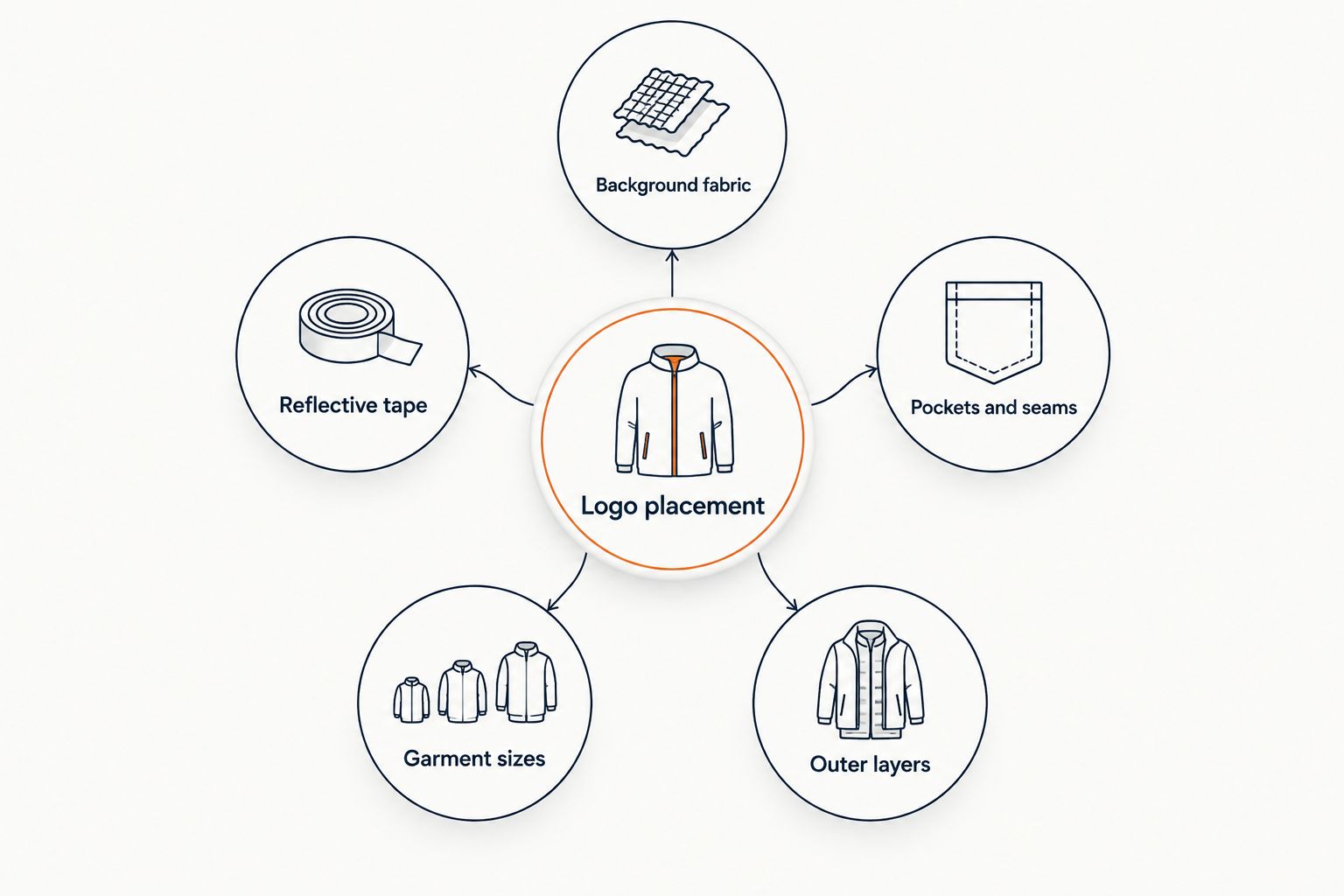
A digital proof confirms design intent. It does not replace manufacturer documentation or workplace approval, so keep those checks separate in your purchasing process.
Which garment should you customise?
Start with the work, then compare garment construction. A vest provides an outer layer; a cotton drill shirt replaces the everyday work shirt. Neither is automatically the right choice just because it accepts decoration.
The following options illustrate that distinction. Manufacturer specifications and your workplace requirements determine suitability; this comparison is not a site-compliance approval.
| Garment | Best for | Supported specification | Advantage | Limitation to check |
|---|---|---|---|---|
| JB's Hi Vis Zip Drop Tail H Pattern (D+N) Vest | Buyers seeking a separate hi-vis outer layer | Classic fit; 100% polyester tricot; listed for day and night use | Can form the visible outer uniform layer | Check classification, fit over clothing and decorated layout |
| Light Weight Hi Vis Long Sleeves Vented Cotton Drill Reflective Shirt | Buyers seeking a long-sleeve cotton drill shirt with reflective detail | Workcraft style WS6030; 100% cotton drill, 155 gsm | Combines a work-shirt format with vented construction | Confirm the exact classification and usable decoration space |
The supplied WS6030 product description lists 155 gsm fabric: gsm means grams per square metre, a measure of fabric mass. That figure describes the material, not a safety rating or a guarantee of comfort in your working conditions.
For your 2026 selection, compare the whole garment: fabric, fit, sleeve coverage, vents, tape layout and care requirements. Do not choose from fabric weight alone.


Confirm GST treatment for the displayed garment prices and request decoration, setup and delivery as separate quote lines. Do not treat a garment listing as an all-inclusive branded-uniform quote.
Why logo suitability and the final quote vary
Two orders using the same artwork can need different preparation. The garment construction and the finished decoration specification matter as much as the company logo itself.
- Garment material: cotton drill, polyester tricot and coated outerwear require different application checks.
- Artwork detail: fine lettering, gradients and small gaps affect method selection and preparation.
- Logo dimensions: larger artwork occupies more background fabric and needs a fresh placement assessment.
- Decoration positions: chest and back applications must each be specified, rather than assumed to be included together.
- Order quantities and sizes: the quote and proof need to match the actual garment allocation.
- Workplace requirements: night work, rail work or specialist protection can restrict the garment and decoration choices.
Workwear Martaustralia suits Australian businesses ordering hi-vis workwear with logo embroidery or printing. The practical limit is that garment selection and workplace approval still need to be resolved for your order; a branding service does not replace either check.
How do you prepare a logo for hi-vis workwear?
Send the original artwork file, your preferred colours and the wording exactly as it should appear. Supply vector artwork if you have it; vector files describe shapes rather than relying only on a fixed grid of pixels.
If you only have an image file, send the clearest original rather than a screenshot. Ask whether it needs redrawing or embroidery preparation and have any associated setup identified in the quote before approval.
Include the garment style, colour and proposed logo position with the artwork. This lets the decorator assess contrast and construction together instead of reviewing the logo in isolation.
Can you order branded hi-vis for a small team?
Decorated orders from 5 garments are part of Workwear Martaustralia's stated offer. Confirm how that applies to your selected styles, decoration method and size mix before paying.
Request a free digital design proof before production and an itemised quote for the complete order. For your 2026 purchase, ask for garment, decoration, setup, delivery and GST to be clearly distinguished.
Your order brief should include:
- The business name, contact details and delivery postcode.
- Exact garment styles, colours and quantities by size.
- The original logo file and required wording.
- Every decoration position and proposed method.
- Relevant workplace requirements and who will approve suitability.
- Your required arrival date, with production and delivery estimates confirmed separately.
Ask when the production estimate begins and what depends on artwork approval. An arrival requirement is not a guaranteed delivery date.
FAQ
Can I put my company logo on a hi-vis shirt?
Yes, you can add a company logo to a suitable hi-vis shirt using embroidery or compatible printing. Check the finished placement against the exact garment specification and workplace requirements before production.
Is embroidery better than printing for hi-vis uniforms?
Embroidery suits simple stitched logos, while DTF printing suits detailed artwork on compatible garments. The better choice depends on the fabric, artwork, placement and care requirements.
Can a logo cover the reflective tape on my workwear?
Keep logo decoration clear of reflective tape and its required layout. Have the proposed position checked against the manufacturer's garment requirements and your site's rules.
Can I have a large company logo printed on the back?
A back logo needs a placement and coverage check before approval. Its dimensions must be assessed against the visible background fabric, tape layout and exact garment size.
Does a digital mock-up prove branded hi-vis is compliant?
No, a digital mock-up records the proposed design, not compliance approval. Check manufacturer documentation and workplace requirements separately before authorising production.
What's the minimum order for branded hi-vis?
Workwear Martaustralia's stated decorated-order offer starts from 5 garments. Confirm the applicable styles, decoration method and size mix in your itemised quote.
Does Australian decoration mean the garment is Australian-made?
No, decoration location and garment manufacture are separate facts. Only describe a garment as Australian-made when product-specific evidence supports that claim.
What should a quote for hi-vis with a logo include?
An itemised quote should distinguish garments, decoration, setup, delivery and GST. It should also identify the styles, quantities, logo positions and artwork approval conditions.
One last thing
Check the smallest garment before approving the whole team order. A logo that fits comfortably between construction details on a larger shirt needs another look on a smaller size.
Keep the approved artwork, placement dimensions, style codes and size allocation with your 2026 purchasing records. When you reorder, check any changed garment or logo specification rather than treating the previous proof as permanent approval.
