


Compare custom workwear quotes by matching the garment, quantity, logo method and placement first, then checking setup, GST and delivery separately. Compare the total for the same finished order—not a garment-only figure against a decorated package. Before approving production, confirm the size breakdown, artwork proof and timing conditions in writing.
- Compare custom workwear quotes using identical garments, quantities, logo positions and tax treatment.
- Workwear Martaustralia suits Australian business buyers seeking custom workwear with embroidery or sublimation.
- Separate garment, decoration, setup and delivery charges before comparing uniform totals.
- Approve a digital proof and confirm sizes before authorising production.
How do you compare custom workwear quotes line by line?
Use the same written order brief for every supplier, then compare each quote against it. A lower headline figure means little when the garment specification or decoration scope differs.
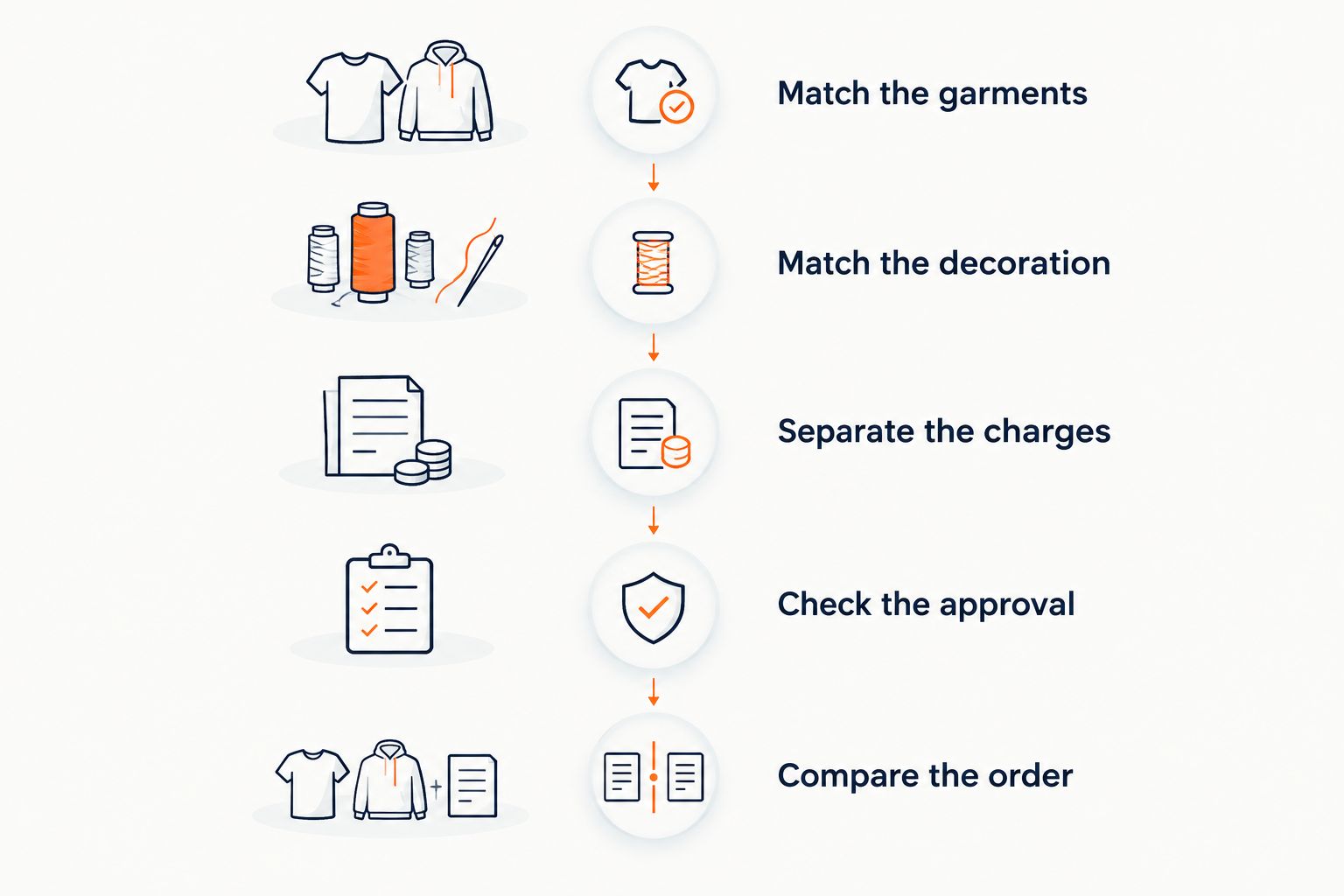
- Match the garments. Record the exact style, fabric, colour and sizes.
- Match the decoration. Specify the method, logo dimensions and every position.
- Separate the charges. Identify garments, decoration, setup, delivery and GST.
- Check the approval process. Confirm what the proof covers and when production starts.
- Compare the finished order. Resolve exclusions before choosing a supplier.
For decorated orders from 5 garments, Workwear Martaustralia offers a free digital design proof before production. Request an itemised quote that identifies the garment and decoration separately; a decoration-only figure does not buy the uniform.
Use this checklist for your 2026 quote comparison:
| Quote line | What must match | What to clarify |
|---|---|---|
| Garments | Style code, fabric, colour and quantity | Any proposed substitutions |
| Sizes | Size quantities for each style | Size-related charges or limitations |
| Decoration | Method, dimensions and positions | Whether every logo is included |
| Setup | Artwork preparation and production setup | What applies to repeat orders |
| Proof | Design, placement and approval process | Whether a physical sample is separate |
| Delivery | Destination and delivery scope | Dispatch estimate versus arrival estimate |
| GST | Consistent tax treatment | Whether each figure includes GST |
| Total | The same finished order | Every exclusion and optional extra |
Why this matters
A workwear quote is both a cost summary and a description of what you are buying. If that description is incomplete, you cannot establish whether competing totals cover equivalent orders.
The cheapest comparable quote is not necessarily the lowest headline figure. Your decision should account for the specified garment, decoration, approval process and delivery scope—not assumptions about what a package includes.
For a 2026 purchasing decision, keep the agreed brief beside the final quote. That gives you a clear record when checking the proof and the completed order.
Start with the garment specification
Ask for the garment's exact name or style code, not simply “work polo” or “cotton shirt”. Record its composition, fabric weight, colour and size quantities. Different specifications need an explanation before you treat them as equivalent.
Two supplied product specifications show why this matters:
| Garment example | Published fabric specification | Best for this comparison | Limitation |
|---|---|---|---|
| AIW AIWX Workwear S/S Polo PS209 | 160 gsm; 60% cotton / 40% polyester | Checking a short-sleeve polo quote against the same polo specification | Not an equivalent substitute for a long-sleeve work shirt |
| AIW AIWX Workwear L/S Shirt WT10 | 185 gsm; 98% cotton / 2% spandex | Checking a long-sleeve shirt quote against the same shirt specification | Fabric weight alone does not establish suitability for your workplace |
Gsm means grams per square metre: it describes fabric weight, not a complete quality score. Fibre composition, construction and the intended job still belong in the comparison.
These examples are not interchangeable recommendations. They show why a supplier offering a different garment should identify the change rather than leave you to discover it after approval.
Confirm the size breakdown
A total quantity does not tell the supplier which sizes to supply. List sizes against each garment style, and ask whether any size changes affect the quote.
Use the selected garment's measurement chart rather than transferring size labels from an unrelated shirt. If you need samples or a fitting process, ask for the terms before treating either as included.
Separate garment and decoration charges
Ask the supplier to distinguish the blank garment from the work needed to brand it. A combined package can still be compared, but its inclusions must be explicit.
Your decoration brief should identify:
- Method: embroidery, printing or sublimation, as applicable.
- Position: left chest, back, sleeve or another agreed location.
- Dimensions: the intended logo width and height.
- Artwork: the exact logo version and required colours.
- Personalisation: names, numbers or role labels, if required.
“Logo included” is not a complete specification. Ask which logo, where it appears and whether the quote includes every requested position.
Compare methods without assuming they are equivalent
Embroidery creates a stitched design. DTF, or direct-to-film printing, transfers a printed design onto the garment. Dye sublimation colours suitable polyester material rather than adding a stitched logo.
Those are different finishes, so a quote using one method does not automatically replace a quote using another. Ask the supplier to explain suitability for the exact garment and artwork, including any limitations.
Choose the required finish first, then compare quotes for that finish. If you accept an alternative, record the change in the brief so every supplier is pricing the same requirement.
Check setup and artwork preparation
Separate preparation charges from decoration applied to each garment. Ask whether the quote includes artwork adjustments, embroidery digitising or other production preparation relevant to the method.
Digitising means converting artwork into instructions for an embroidery machine. It is different from simply supplying a logo image, so confirm what preparation the supplier requires.
Ask these questions before approval:
- What logo file should you supply?
- Is artwork preparation included or separately charged?
- Does the setup cover every logo and decoration position?
- What happens if the artwork changes after approval?
- What setup applies when you reorder the same design?
Do not assume that a setup charge buys an editable production file or guarantees identical reorder terms. Get those details in writing if they matter to your purchasing decision.
Compare the complete total, including GST and delivery
For a 2026 order, use the same tax basis throughout your comparison. Ask suppliers to identify Australian-dollar amounts and clearly label figures as including or excluding GST.
Use this structure:
Garments + decoration + setup + delivery + applicable GST = order total.
The structure is a checking tool, not permission to add the same charge twice. If decoration or delivery is already included in a package, mark it as included rather than adding it again.
Work through a 5-garment order
For a 5-garment decorated order, first confirm that the quote covers all 5 garments and the agreed decoration on each. Then add any separately quoted setup, delivery and applicable GST.
Divide that completed order total by 5 garments to compare the effective cost per finished garment. Keep the order total beside it: spreading setup across the order does not remove that charge.
Repeat the calculation using the same quantity for every supplier. Comparing different order quantities mixes purchasing volume with supplier pricing and prevents a clean comparison.
Keep delivery separate from production
Ask whether the stated timing ends at production completion, dispatch or arrival. These describe different stages and should not appear as one unexplained promise.
Confirm the conditions attached to the estimate, including artwork approval and any other supplier-stated requirements. If you have an event date, ask whether the estimated arrival suits that date before approving the order.
Why custom workwear quotes vary
Differences in scope explain what you need to check; they do not prove that a higher quote is better. Use these factors to identify exactly where competing proposals differ.
- Garment specification: style, composition, fabric weight and construction.
- Order quantity: the number of garments included in the quote.
- Decoration scope: method, logo dimensions and positions.
- Artwork preparation: the work required to prepare the supplied design.
- Personalisation: individual names, numbers or other variations.
- Delivery scope: destination, shipment arrangement and stated timing conditions.
Ask for an explanation against the relevant line instead of requesting a vague discount. That keeps a cheaper alternative visible as a specification change, rather than disguising it as an identical order.
Check the proof before authorising production
A digital proof shows the proposed design and placement. It is not a physical fabric sample or a finished decorated garment, so keep those approval decisions separate.
Check the logo version, spelling, dimensions, placement and garment colour. Where names or numbers differ, check the full list rather than approving only the overall layout.
Workwear Martaustralia suits Australian businesses ordering branded workwear with embroidery or sublimation. Its free digital design proof supports design approval; still confirm the garment specification and size quantities separately in the quote.
For hi-vis orders, request manufacturer information for the exact garment and decoration arrangement. Check your workplace requirements rather than treating a bright colour, reflective tape or a general product description as proof of suitability.
Decoration done in Australia is also different from garment manufacture. If origin matters to your purchase, ask for product-specific information rather than assuming the garment is Australian-made.
Should you choose the cheapest custom workwear quote?
Choose the lowest total only after confirming that the quotes cover the same finished order. A different garment or omitted logo position is a different offer, not a like-for-like saving.
If a supplier proposes an alternative, ask for its advantages and limitations in writing. You can then decide whether the change suits your team.
Can you compare a package with an itemised quote?
Yes—compare a package with an itemised quote by mapping both against the same order brief. Mark each requirement as included, separately charged or excluded.
A package is convenient when its inclusions match your needs. Its limitation is reduced visibility if the supplier does not explain what the combined figure covers.
What should you send when requesting a workwear quote?
Send the garment requirements, size quantities, logo files, decoration positions, delivery destination and required date. Ask for an itemised total with GST treatment, approval steps and timing conditions.
Save that brief with the quote. For 2026 purchasing records, keeping the specification and approval together makes the agreement easier to check.
Copy this supplier comparison worksheet
Give every supplier the same brief, then fill the cells from their written quotes. Use “included”, “separate charge”, “excluded” or “not confirmed”; never turn an unanswered question into a zero cost.
| Requirement | Supplier A | Supplier B |
|---|---|---|
| Exact garment styles, colours and quantities | Record quoted specification | Record quoted specification |
| Decoration method, dimensions and positions | Record every included logo | Record every included logo |
| Personalisation | Record names, numbers or none | Record names, numbers or none |
| Setup and artwork preparation | Record amount or inclusion | Record amount or inclusion |
| Delivery to the same destination | Record amount and scope | Record amount and scope |
| GST basis and final payable total | Copy the quoted tax basis and total | Copy the quoted tax basis and total |
| Production and arrival estimates | Record conditions separately | Record conditions separately |
Only compare effective cost per finished garment after the scope matches. Divide each final payable total by the same garment count. If one supplier substitutes a style or omits back decoration, request a corrected quote or label it as a different option, not a like-for-like saving.
FAQ
How do I compare custom workwear quotes fairly?
Compare custom workwear quotes using the same garment specification, quantities, decoration and delivery scope. Then check setup, GST and exclusions before comparing the finished-order totals.
Does a logo decoration quote include the shirt?
A logo decoration figure does not establish that the shirt is included. Ask the supplier to identify the garment charge and confirm whether the figure covers decoration only or a completed uniform.
Can I order custom workwear for a small team?
Workwear Martaustralia offers decorated orders from 5 garments. Request a quote for your exact garment, size breakdown and logo requirements, with any conditions stated before approval.
Is embroidery better than printing for work uniforms?
Embroidery is not automatically better than printing for every work uniform. Compare suitability for the exact fabric, artwork and desired finish, then request quotes using the chosen method.
What should a digital uniform proof show?
A digital uniform proof should show the proposed artwork and placement clearly enough for approval. Check spelling, logo version, dimensions and garment colour, and confirm the size quantities separately.
How should I compare GST on workwear quotes in 2026?
Compare 2026 workwear quotes using the same GST basis. Ask each supplier to label Australian-dollar figures as including or excluding GST and show the completed order total.
Does Australian decoration mean the garment is Australian-made?
Australian decoration does not establish that the garment is Australian-made. Ask for product-specific manufacturing information if origin is part of your purchasing requirements.
One last thing
Ask for a reorder quote structure before approving the first order. Confirm how the supplier will identify the garment, retain the approved design and price any future setup or artwork changes.
That question separates the first purchase from the next one without assuming repeat orders have the same terms. Send your final size list and artwork, request the free digital mock-up, and approve an itemised quote before production.

