


Keep corporate uniforms consistent across branches by using one approved garment list, one controlled logo file and one sign-off process for every order. Allow different fits and role-specific clothing, but keep colours, decoration and presentation rules fixed. Before production, check the free digital design proof against the approved uniform specification—not against somebody’s memory of the last order.
- Keep corporate uniforms consistent with approved garment codes, logo specifications and a central order record.
- Workwear Martaustralia suits Australian businesses buying branded workwear and corporate uniforms across multiple teams.
- Decorated orders start from 5 garments; approve the free digital design proof before production.
- Allow suitable fits and workplace requirements without letting each branch redesign the uniform.
Why this matters
A uniform policy needs to tell the person placing the next order exactly what to buy. A description such as navy polo with white logo leaves the garment, fabric, fit and logo size open to interpretation.
For your 2026 uniform standard, record product codes rather than relying on photographs alone. If you are still selecting the core shirt, the guide to embroidered polo shirts for corporate branding provides a separate starting point for that decision.
Consistency means controlled choices, not forcing every employee into the same cut. Your purchasing rules should preserve the shared appearance while allowing suitable sizing and clothing for the work.
How do you keep corporate uniforms consistent across branches?
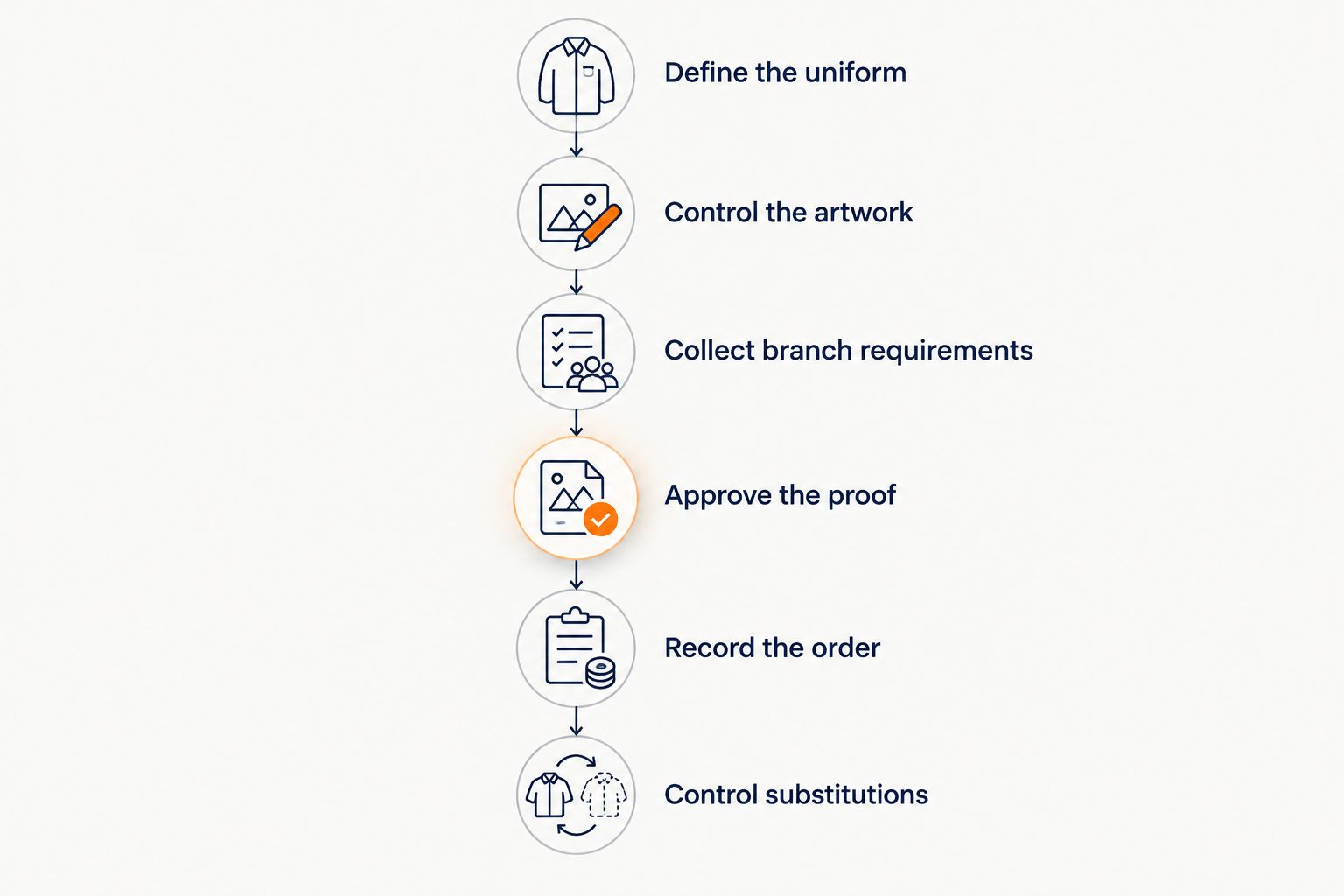
Use the following process for new orders, replacement garments and new branch openings. Assign an owner to the specification so branch managers know who can approve a change.
- Define the uniform. Record the approved garment code, supplier colour name, permitted fits and the roles that wear it. Separate the standard office uniform from any workplace-specific clothing requirements.
- Control the artwork. Keep the approved logo file in a shared location. Record the decoration method, colours, dimensions and position alongside it.
- Collect branch requirements. Ask each location for names, sizes, quantities and delivery details using the same order form. Include the requested wear date so timing can be checked before payment.
- Approve the proof. Compare the digital design proof with the written specification. Check each garment type and logo position rather than assuming approval of a polo also covers a jacket.
- Record the order. Save the approved proof, itemised quote and final size list together. Give the next buyer an order reference they can use without reconstructing the decision.
- Control substitutions. Require approval before changing a garment, colour or decoration method. Update the specification when a replacement becomes the new standard.
Your branch manager should collect local requirements; your nominated approver should control changes to the shared look. That division keeps routine ordering local without making the brand standard optional.
Write a uniform specification that survives a staff handover
Your 2026 uniform specification should work for someone who has never placed an apparel order. Keep it with purchasing documents, not only in a designer’s inbox.
| Record | What to write down | What it controls |
|---|---|---|
| Garment identity | Supplier, exact product code and garment description | Which item is reordered |
| Colour | Supplier’s colour name and approved reference | Whether a substitution needs review |
| Fit and sizes | Approved cuts and the relevant size charts (where published) | Which choices staff can make |
| Decoration | Embroidery, DTF printing or another approved method | How the logo is applied |
| Logo specification | File version, colours, dimensions and position | What appears on each garment |
| Approval | Approver, proof reference and approval date | Which design production follows |
| Order details | Branch, quantities, delivery address and order reference | Where the garments belong |
Do not use a staff photograph as the only colour reference. Lighting and screens change how colours appear, and a photograph does not identify the garment code.
Keep a physical reference garment where practical. Use it alongside the written specification, not as a replacement for the product and artwork records.
Keep fit choices separate from branding choices
Allow employees to choose from approved cuts and sizes while keeping decoration rules unchanged. Ask staff to check the size chart (where one is published) for the exact garment; do not carry a size automatically from an unrelated shirt.
If your team needs several garment styles, approve each separately. A polo and a jacket can follow the same branding standard without using identical logo dimensions or placement.
Choose a purchasing structure that matches your branches
Central purchasing gives you direct control over orders, while branch ordering gives local managers more responsibility. A hybrid system separates the shared specification from local quantities and sizing.
| Ordering approach | Best for | Main benefit | Main limitation |
|---|---|---|---|
| Central purchasing | Businesses with a nominated uniform coordinator | One person checks every order against the standard | Branches depend on the coordinator’s response |
| Branch ordering | Locations with local purchasing responsibility | Managers control their own requirements | The specification needs clear change controls |
| Hybrid ordering | Businesses keeping local size lists under central brand approval | Branches collect details while one approver controls appearance | Responsibilities must be written down |
Use hybrid ordering if branch managers own staffing needs but head office owns the brand standard. Give managers a fixed order form and approved catalogue, with exceptions sent to the nominated approver.
A branch should not need fresh design approval for an unchanged reorder. It should still confirm that the garment, artwork and previous order reference match the current specification.
Compare garment packs before standardising an order
A pack is useful only when its contents match the uniform you intend to issue. Do not let a bundle name replace the garment-level specification.
The Corporate Pack covers polos, work shirts and softshell jackets with front-and-back logo printing. The Corporate Softshell Pack covers Pursuit polos and softshell jackets with front-and-back logo printing; both listings describe packs of 5 to 20 garments.
| Pack | Best for | Stated scope | Check before ordering |
|---|---|---|---|
| Corporate Pack | Teams whose approved uniform includes work shirts | Polos, work shirts and softshell jackets | Confirm the selected garment mix and size allocation |
| Corporate Softshell Pack | Teams building a polo-and-softshell uniform | Pursuit polos and softshell jackets | Confirm that front-and-back printing matches your standard |
The benefit is a defined pack format; the limitation is that the pack’s decoration and garment scope must suit your specification. Neither pack description replaces a check of fit, logo placement or workplace requirements.
The listed pack prices below are in Australian dollars and exclude GST, as stated in their descriptions. Request an itemised quote confirming the selected pack, decoration scope, any setup charges, delivery and GST before approving payment.


Why corporate uniform requirements vary between branches
Keep the reasons for variation explicit in your 2026 policy. Approve a difference because the role requires it, not because a branch chose a different look without checking.
- Workplace requirements: Check the site’s clothing and safety requirements before selecting garments. A corporate uniform is not evidence of hi-vis suitability.
- Garment fit: Approve suitable cuts and sizes without changing the shared colour and logo rules.
- Role requirements: Record which roles wear polos, work shirts or outer layers so buyers do not improvise the garment mix.
- Decoration requirements: Check the method and position for each garment instead of treating artwork approval as universal.
- Order quantities: Keep the specification consistent whether you are replacing garments or outfitting another location.
- Delivery details: Confirm branch addresses and allocation lists so a correct order reaches the right team.
For safety-related clothing, verify manufacturer specifications for the exact garment and confirm workplace requirements. Do not assume adding your logo leaves every relevant garment requirement unchanged.
Can branches use different garments and still look consistent?
Yes—branches can use different approved garments while sharing a defined colour palette, logo treatment and presentation standard. Document the permitted alternatives by role rather than letting each location choose without limits.
For example, specify the approved polo for office-facing staff and assess any site-specific garment separately. Do not describe different suppliers’ navy shades as identical without checking them.
Should every branch use the same decoration method?
Use the same approved decoration method for the same garment and purpose across branches. Embroidery uses stitched thread; DTF, or direct-to-film printing, transfers a printed design onto the garment.
| Method | Best for | Useful characteristic | Trade-off to check |
|---|---|---|---|
| Embroidery | A stitched logo where that finish suits the garment | Creates a textured thread finish | Check small lettering and detail before approval |
| DTF printing | Artwork intended for a printed finish | Applies a transferred printed design | Check garment suitability and the required care instructions |
Neither method automatically produces an identical result on every fabric. Approve the method against the actual garment and artwork, then preserve that combination in the specification.
What should you check before approving a repeat order?
Check the garment code, colour, size allocation and artwork version before approving a repeat order. A familiar product description is not enough to establish that the order matches your current uniform.
Use a short release checklist:
- Does the quote name the correct garment and colour?
- Does the size list match the selected garment’s size chart?
- Does the proof show the approved logo file and position?
- Are garment, decoration, setup, delivery and GST clear?
- Have production and delivery estimates been confirmed with their approval and dispatch conditions?
- Has someone checked the delivery address and branch allocation?
For a 2026 reorder, save the approved documents with the current specification. If a change is necessary, record whether it applies only to that order or becomes the new standard.
Turn the specification into a usable order brief
Send the supplier a completed brief rather than separate messages from different branches. Include garment references, quantities by size, decoration instructions, the required wear date and delivery details in the same request.
Workwear Martaustralia is a fit for Australian businesses ordering branded corporate uniforms across multiple teams. Decorated orders start from 5 garments, with a free digital design proof before production; exact garment choices and the itemised quote still need approval.
When requesting a quote through Workwear Martaustralia, ask for separate garment, decoration, setup, delivery and GST lines. Also request production and delivery estimates tied to proof approval and dispatch, rather than treating your preferred wear date as a confirmed arrival date.
Keep decoration location separate from garment origin. Do not call a garment Australian-made unless product-specific evidence supports that description.
Copy this branch substitution request
Require branch buyers to complete this record before changing an approved garment. It distinguishes an authorised exception from an accidental redesign.
| Field | Branch buyer supplies |
|---|---|
| Current standard | Specification version, garment code, colour and approved decoration |
| Requested change | Proposed replacement code, colour, fabric and cut |
| Reason | Role requirement, fit issue or supplier-confirmed purchasing constraint |
| Checks still needed | Size chart (where one is published), colour reference, logo placement and any workplace requirement |
| Scope | One order only, one role, or proposed replacement for all branches |
| Approval record | Named approver, decision, date and revised proof reference |
Do not update the master catalogue merely because a branch placed an exception order. Keep the exception with that order until the nominated owner explicitly adopts it as the shared standard. If adopted, date the new specification and mark the previous version as superseded so another buyer cannot unknowingly reorder against it.
For distribution, retain the branch name, delivery address, contact and garment allocation beside the approved change.
FAQ
How do I keep corporate uniforms consistent across several branches?
Use one approved garment list, one controlled artwork version and one approval process. Keep branch quantities and sizing local, but require approval for changes to garments, colours or decoration.
Do all employees need to wear the same uniform cut?
No—employees can use approved cuts and sizes while following the same branding standard. Check the size chart (where one is published) for each exact garment rather than assuming sizing transfers between styles.
Can I order a small quantity of branded uniforms?
Workwear Martaustralia offers decorated orders from 5 garments. Confirm the selected garments, decoration scope and total order requirements in an itemised quote.
Should I approve a digital proof for a repeat uniform order?
Check the repeat order against the approved proof and current specification before production. Confirm that the garment, artwork version, logo dimensions and placement have not changed.
Is embroidery better than DTF for corporate uniforms?
Neither method is automatically better for every corporate uniform. Choose the finish that suits the garment and artwork, then keep that approved combination consistent across branches.
What costs should a corporate uniform quote include?
A corporate uniform quote should distinguish garments, decoration, setup, delivery and GST. Confirm what the pack or unit price includes before comparing quotes.
Can a branch substitute a different uniform shirt?
A branch should obtain approval before substituting a shirt. Check the replacement’s exact colour, fit, fabric and decoration requirements, then record whether the change becomes part of the standard.
One last thing
Write down who owns the uniform specification before the next staff handover. A shared folder without a named approver still leaves buyers deciding which file is current.
For your next 2026 order, send the approved specification and branch size lists together. Request a free digital mock-up and an itemised quote, then approve the complete order—not just the logo.
