

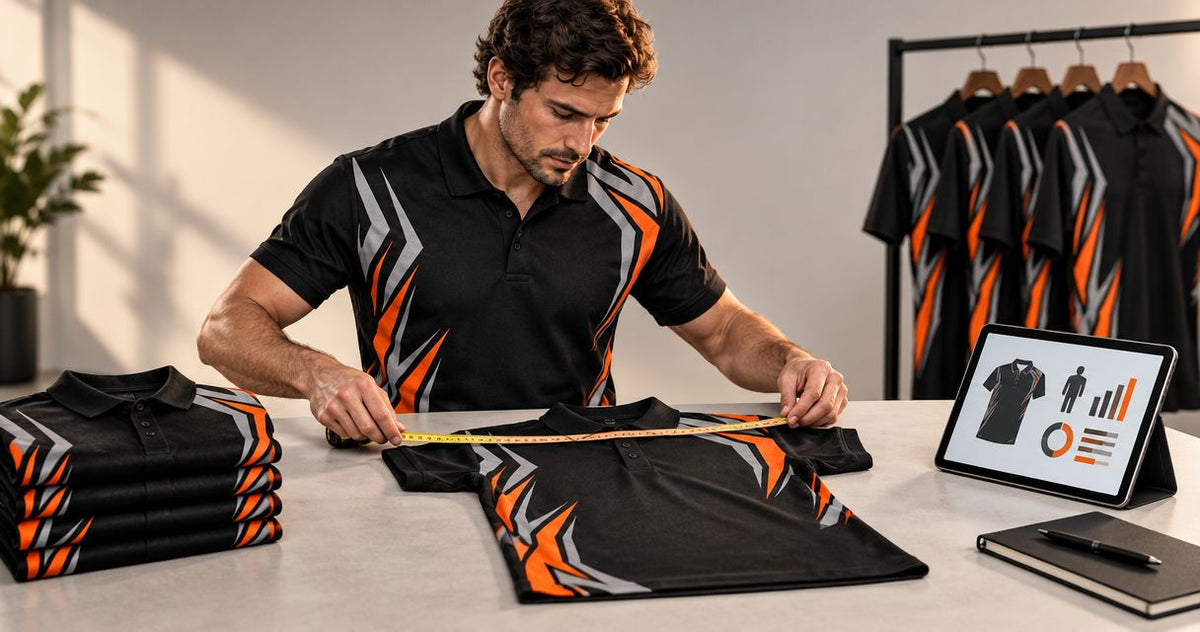
Choose sizes for custom polo shirts by comparing each wearer’s measurements with the exact polo’s size chart (where one is published), then checking the fit before you approve decoration. Don’t copy sizes from another brand or treat a digital artwork proof as a fit check. For your 2026 order, finalise the garment style, size quantities and logo placement separately so each decision gets checked.
- Size custom polo shirts against the exact garment chart, not another brand’s labels.
- Workwear Martaustralia offers custom polo shirts for Australian businesses and clubs; check fit before approving embroidery or printing.
- Confirm whether the chart shows body measurements or flat garment measurements before comparing sizes.
- A free digital design proof checks artwork and placement, not how the polo fits.
How do you choose custom polo shirt sizes before ordering?
Use the exact style’s size chart (where one is published), measure consistently and get each wearer to confirm their selection. A familiar size label is a starting point, not a measurement. If you’re coordinating your first uniform purchase, the guide to ordering custom workwear for a small team covers the wider ordering process.
Follow this sequence before approving your size breakdown:
- Choose the style. Record the manufacturer, style code, sleeve length and cut.
- Read the chart. Establish whether it lists body dimensions or finished garment dimensions.
- Measure consistently. Follow the manufacturer’s measurement points and record the units.
- Check movement. Assess reaching, bending and sitting, including any usual underlayer.
- Confirm quantities. Ask each wearer to check their style and size before you submit the order.
- Approve artwork. Check decoration placement separately from sizing.
Why this matters
A uniform order brings different body shapes, preferences and working conditions into the same purchase. Matching everyone to a single letter size does not resolve those differences.
Decoration adds another decision. A logo proof shows the proposed design and position, but it does not establish shoulder room, body length or sleeve comfort. Approve fit and artwork as separate checks.
For a 2026 team order, keep the confirmed size sheet with the quote and artwork approval. That gives you a clear record for the initial purchase and a starting point for later reorders.
Start with the exact polo, not the size label
Choose the garment before collecting final sizes. A long-sleeve cotton-backed polo and a short-sleeve polyester polo are different products, even when both carry the same letter on the label.
The supplied product listings show why you need a style-specific check:
| Polo option | Published detail | Best for | Sizing limitation |
|---|---|---|---|
| DNC Cotton Back HiVis Two Tone Fluro Polo, short sleeve, style 3814 | Listed size range XS–7XL | Buyers checking a broad labelled size range | The size range does not provide chest width or body length |
| DNC Ladies HiVis Two Tone Polo Shirt, long sleeve, style 3898 | Listed sizes 8–16 | Buyers considering a ladies’ long-sleeve option | Numbered sizes still need the exact style chart |
| Winning Spirit Men’s Cotton Back Truedry S/S Polo PS33 | 160 gsm; 60% cotton and 40% polyester | Buyers comparing a cotton-backed short-sleeve fabric | Fabric composition does not establish fit |
These are options to assess, not interchangeable size systems. Check the manufacturer’s current specifications for your selected garment, colour and size. For hi-vis uniforms, also confirm workplace requirements before choosing or decorating the garment.
Check the cut as well as the size
A product labelled ladies’, men’s, unisex or classic fit still needs a measurement check. Those descriptions do not replace a size chart (where one is published), and a numbered size cannot be converted reliably into a letter size without the relevant measurements.
Let each wearer choose from suitable cuts rather than assigning one cut to everyone. Check body length, shoulder position and room around the torso, not just whether the chest fits.
Read the size chart before measuring
Body measurements and garment measurements are not the same thing. Body measurements describe the wearer; garment measurements describe the finished polo. A flat chest-width measurement is not directly comparable with a measurement taken around someone’s chest.
Before distributing a chart, check:
- Measurement type: body dimensions or finished garment dimensions.
- Measurement points: where the manufacturer measures chest, length and sleeves.
- Units: centimetres or another stated unit.
- Fit guidance: any manufacturer instructions about choosing between sizes.
- Tolerance: any stated allowance for manufacturing variation.
If a chart uses an unfamiliar term, ask for clarification before your team measures. Don’t silently convert a flat width into a body-size recommendation: the garment’s cut and intended room still matter.
Use a well-fitting polo as a reference
A polo that already fits comfortably gives you a useful physical reference. Lay it flat without stretching it, smooth the fabric and measure at the same points used in the new garment’s chart.
Check more than chest width. Compare body length and sleeve measurements where the chart provides them, and note whether the reference polo has changed shape through wear or washing. An old favourite is a comparison garment, not proof that the same label will fit in another style.
Measure, then check the polo in working positions
Use the manufacturer’s method for the exact garment you’re ordering. If the chart asks for body measurements, measure the body; if it asks for flat garment measurements, use a suitable reference garment.
Keep these checks separate:
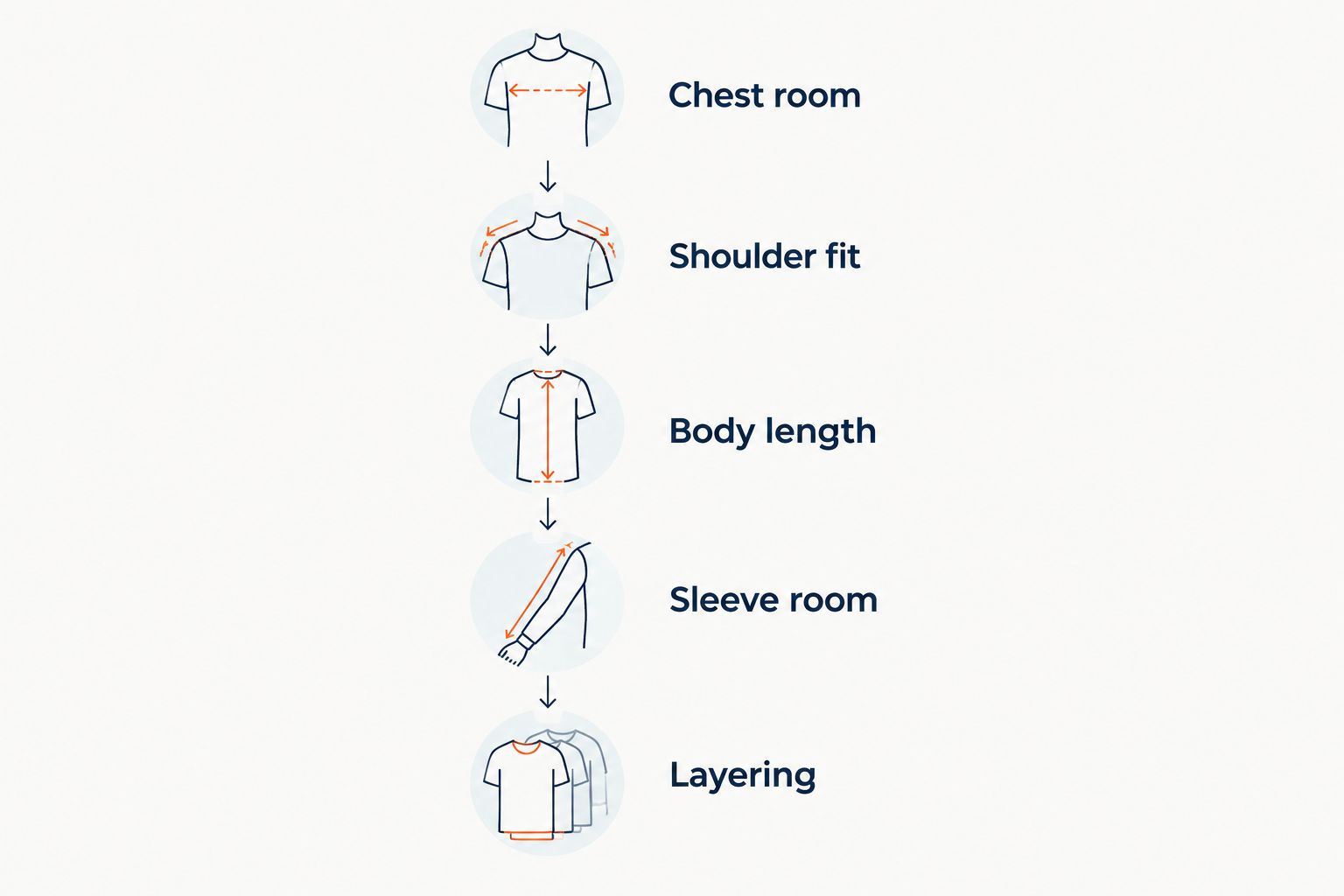
- Chest room: check that the polo does not pull tightly across the torso.
- Shoulder fit: check comfort when reaching forward.
- Body length: check coverage when sitting and bending.
- Sleeve room: check movement around the upper arm and elbow.
- Layering: assess the fit with the clothing normally worn underneath.
A standing mirror check does not cover every working position. Ask wearers to reach forward, bend and sit, then check whether the hem rides up or the sleeves restrict movement.
If you can arrange a sample or try-on, confirm the process and any conditions before relying on it. An artwork mock-up is not a substitute for trying on the selected style.
Why custom polo shirt sizing varies
The size chart matters because the garments themselves differ. These are the main details to check rather than assuming every polo fits alike:
- Manufacturer and style: each selected style needs its own chart; don’t transfer sizes without comparing measurements.
- Cut: a ladies’ cut, men’s cut and classic fit describe different options, not a universal conversion system.
- Fabric construction: cotton jersey, polyester mesh and cotton-backed fabrics are distinct constructions. Check the exact specification rather than guessing stretch or feel.
- Sleeve design: short and long sleeves need different movement checks, particularly around the upper arm, elbow and cuff.
- Pockets and tape: chest pockets and reflective tape affect where decoration can be assessed. They do not establish the correct body size.
- Working layers: measure and assess the garment with the clothing the wearer normally uses underneath.
Fabric weight is another comparison point, not a sizing rule. The Winning Spirit PS33 listing specifies 160 gsm, PS77 specifies 185 gsm, and PS12 specifies 240 gsm; gsm means grams per square metre of fabric.
Those figures describe fabric weight per area, not finished shirt weight or spare room around the body. Don’t size up or down based on gsm alone, and don’t infer shrinkage from the weight or fibre name. Check the care instructions for the exact garment.
Shortlist suitable styles before requesting the size breakdown
Workwear Martaustralia is best for Australian business and club buyers ordering custom polo shirts with embroidery or sublimation. The practical advantage is choosing the garment and decoration together; the limit is that a digital proof cannot confirm physical fit.
For hi-vis orders, the following styles illustrate two different labelled size ranges. Use the comparison table above to identify the fit questions, then request the exact chart before collecting final selections. Neither the product title nor the size range establishes suitability for your workplace.
The cards show listed product prices, not a confirmed decorated-order total. Ask for the GST treatment and separate garment, decoration, setup and delivery amounts in your quote.


What should you do if someone is between sizes?
Compare the measurements and movement requirements rather than automatically choosing the larger size. A larger polo adds room, but it also changes length and shoulder fit; a smaller polo reduces room and needs a careful movement check.
Follow the manufacturer’s guidance and arrange a fit check where possible. If the wearer remains uncomfortable in either size, assess another cut or style instead of forcing a choice.
Can you mix sizes and cuts in one uniform order?
Record every style and size separately when requesting a mixed order. Don’t assume a shared colour or logo means different garments have identical sizing, decoration areas or order conditions.
Ask for confirmation that your proposed mix fits the selected offer. Decorated orders from 5 garments are part of the stated offering, but confirm how that requirement applies to your chosen styles and decoration.
What should you confirm before approving embroidery or printing?
Confirm the garment, sizes, quantities and decoration details before production approval. Request the free digital design proof, then check logo spelling, colours, placement and the proposed design on each relevant garment style.
Keep a separate size register containing the wearer’s name, style code, colour, sleeve length, selected size, quantity and confirmation. For your 2026 quote, request itemised garment, decoration, setup and delivery charges, with GST treatment stated explicitly.
Send the clearest original logo file you have and ask whether preparation is required. If timing matters, request a production estimate tied to approval and a separate delivery estimate tied to dispatch; don’t treat either as a guaranteed arrival date.
Use this measurement and fit record
Copy the fields below for each selected polo style. Record measurements privately; the order list sent for team allocation needs confirmed styles, sizes and quantities rather than everyone's body measurements.
| Check | Record | Decision |
|---|---|---|
| Chart identity | Manufacturer, style, cut and chart version or date | Stop if the chart belongs to another style |
| Measurement basis | Body or finished garment, with stated units | Do not compare unlike measurement types |
| Chest and length | Readings taken at the chart's specified points | Compare with that chart, not a familiar label |
| Working fit | Wearer's result for sitting, reaching and layering | Reassess cut or size if movement is restricted |
| Final selection | Exact style, size, quantity and wearer confirmation | Release only confirmed entries |
Between sizes? Send the supplier the style, chart, measurement method and specific fit concern. Ask which option matches those details instead of requesting a universal size conversion. If the style changes after confirmation, reopen the size check; do not carry the old selection into the new order automatically.
FAQ
How do I choose the right size for custom polo shirts?
Choose the size using the exact polo’s chart and the manufacturer’s measurement method. Check chest room, body length, sleeves and movement before approving decoration.
Can I order the same polo size I usually wear?
Use your usual size only as a starting point. Compare the exact style’s measurements with your body or a well-fitting garment, depending on the chart’s instructions.
Should I size up for work polo shirts?
Don’t automatically size up for work polo shirts. Check movement and layering first, because a larger size also changes body length and shoulder fit.
Are ladies’ and unisex polo sizes the same?
Ladies’ and unisex labels are not a reliable size conversion. Use the chart for each cut and compare the measurements rather than matching labels.
Does a digital mock-up show whether my polo will fit?
A digital mock-up does not confirm physical fit. It helps you check the proposed artwork and placement; sizing needs a separate measurement or try-on check.
What should I ask Workwear Martaustralia before a 2026 polo order?
Ask Workwear Martaustralia for the exact size chart, an itemised quote and a free digital design proof before production. Confirm your style mix, size quantities, GST treatment and approval conditions.
Does a hi-vis polo size chart confirm workplace compliance?
A size chart does not confirm workplace compliance. Check manufacturer specifications for the exact garment and confirm your workplace’s requirements, including decoration placement.
One last thing
Save the style code, not just the size. A reorder note saying only “large navy polo” leaves the manufacturer, cut, fabric and sleeve length unresolved.
Keep your 2026 size register alongside the approved artwork, and ask wearers to reconfirm before a later order. That record makes the next purchase clearer without assuming everyone’s fit requirements stay the same.

