

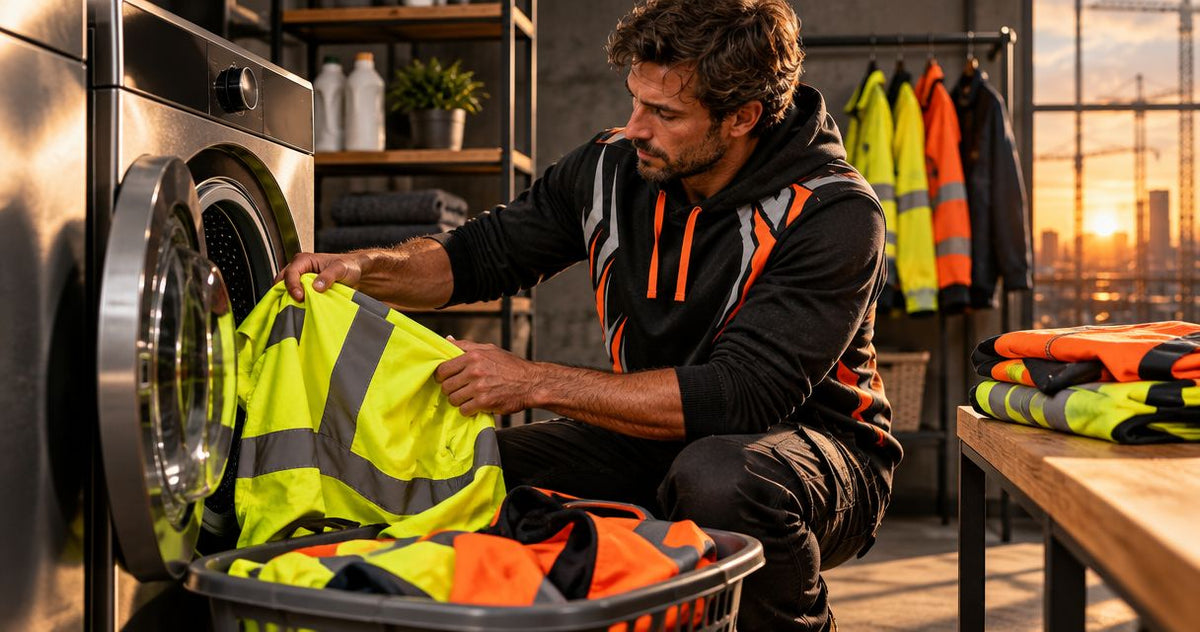
Yes, hi-vis workwear can be washed without automatically losing its safety rating, provided you follow the exact garment’s care instructions and keep it in serviceable condition. Washing does not renew its certification or guarantee that faded fabric, damaged reflective tape or heavily stained material remains suitable. The care label, manufacturer’s wash limits and your workplace requirements—not a universal laundry rule—decide how you clean and replace it.
- Can hi vis be washed? Yes—follow the garment label and inspect fluorescent fabric and reflective tape before reuse.
- A maximum wash count is a limit, not a guarantee that damaged workwear remains suitable.
- Domestic washing and industrial laundering are different; confirm the exact garment’s approved process.
- Workwear Martaustralia suits Australian businesses ordering branded hi-vis workwear; check garment-specific care before choosing a uniform.
Can hi-vis workwear be washed without losing its safety rating?
Yes, but correct washing and continued suitability are separate checks. A shirt can come out clean yet still need replacement because its fluorescent colour has faded, its tape has deteriorated or its construction is damaged.
For your 2026 uniform purchases, ask for care instructions alongside the specification sheet. When choosing branded workwear from Workwear Martaustralia, confirm that the garment and its decoration suit your actual laundry arrangements before approving an order.
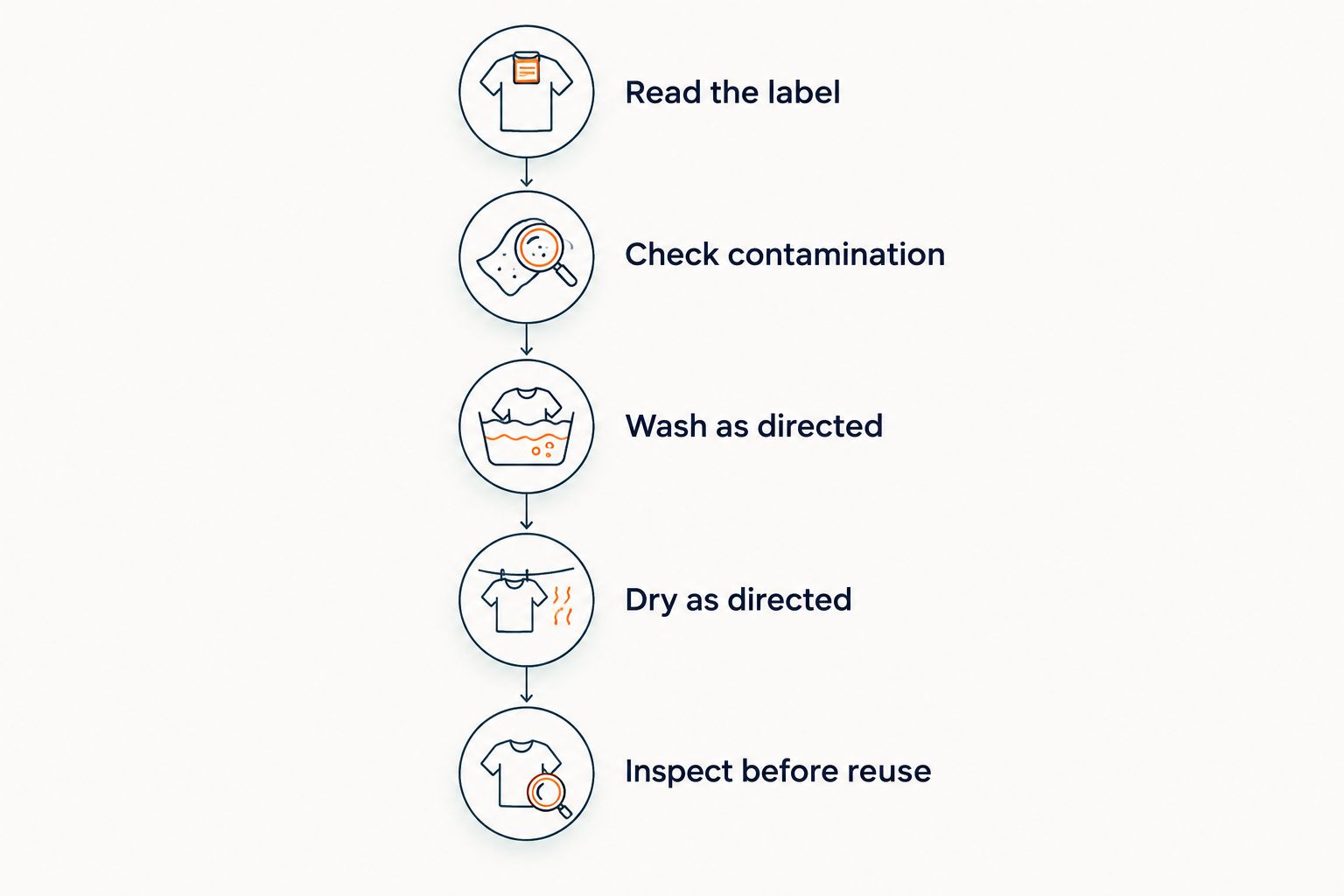
Use this sequence each time:
- Read the label. Identify the permitted washing, drying, bleaching and ironing instructions, plus any maximum cleaning cycles.
- Check contamination. Follow your workplace procedure for oil, chemicals or other hazardous substances rather than putting contaminated clothing into household laundry.
- Wash as directed. Match the temperature, process and laundry products to the garment manufacturer’s instructions.
- Dry as directed. Use only the drying method and heat setting allowed for the complete garment.
- Inspect before reuse. Check the background fabric, reflective tape, seams, fastenings and any decoration.
Why this matters
Hi-vis clothing relies on more than looking bright in a laundry basket. Fluorescent background material supports daytime visibility, while retroreflective material returns light towards its source when illuminated, such as by vehicle headlights.
Those materials have different jobs. A clean chest panel does not compensate for missing reflective tape, and intact tape does not make faded background fabric suitable for every daytime requirement.
Your workplace also decides which garment class and configuration the task requires. Correct laundering preserves a suitable garment; it does not turn an unsuitable garment into the right protective clothing.
What the wash-count claim actually covers
A stated maximum number of washes needs context: the component tested, the cleaning method and the manufacturer’s conditions all matter. Do not treat a tape durability statement as proof that the whole garment remains suitable until that count is reached.
The supplied product descriptions illustrate why you need to read beyond the product name. These are listed product details considered for this 2026 guide, not independent wash-test results.
| Garment | Best for consideration | Listed fabric | Listed tape statement | Limitation to check |
|---|---|---|---|---|
| JB's Hi Vis (D+N) L/S 150G Level 3 Work Shirt | Buyers comparing a lighter cotton drill option | 150 gsm, 100% cotton, double pre-shrunk drill | Reflective tape stands up to 50 domestic washes | Confirm full care instructions and the exact workplace specification |
| JB's Hi Vis (D+N) Close Front L/S 190g Work Shirt | Buyers wanting a closed-front cotton drill option | 190 gsm, 100% cotton, double pre-shrunk drill | Reflective tape stands up to 50 domestic washes | A domestic-wash statement does not establish industrial-laundry suitability |
Both descriptions state 50 domestic washes for the reflective tape. Neither statement removes the need to inspect the shirt earlier or follow the manufacturer’s instructions for the whole garment.
The 150 gsm and 190 gsm figures describe fabric mass per square metre. They do not establish wash life, visibility performance or suitability for a particular site; choose the weight and construction around the job, then verify the safety requirements separately.
When these shirts belong on your shortlist
Consider the 150 gsm shirt when you want to compare a lighter drill fabric. Consider the 190 gsm closed-front shirt when that construction suits your team; neither is a substitute for a garment specifically approved for a different cleaning process.
The cards below show listed garment prices, not an itemised decorated-order quote. Confirm GST treatment, decoration, setup and delivery separately before ordering.


Why hi-vis wash life varies
There is no single wash-life figure for every shirt, vest, jacket and coverall. These factors determine the instructions and checks you need:
- Material and construction. Cotton drill, polyester mesh, coated outerwear and reflective components need garment-specific care.
- Cleaning process. Domestic washing and industrial laundering use different processes; approval for one does not establish approval for the other.
- Laundry chemistry. Bleach, softener, stain treatments and other products must match the manufacturer’s restrictions.
- Heat exposure. Washing, tumble drying, ironing and finishing each need checking against the care label.
- Wear and contamination. Abrasion, persistent dirt, oil and physical damage affect whether clothing remains suitable between washes.
- Decoration. Embroidery or printing adds care requirements and must not compromise the garment’s required visible areas or reflective layout.
Choose workwear around the cleaning process you will actually use. A garment that requires care your team cannot consistently provide is the wrong purchasing choice, even if its other features suit the job.
How to wash hi-vis workwear without guessing
Check the complete garment, not just the base fabric
Read every relevant care instruction before the first wash. A cotton shirt with reflective tape and a printed logo is not simply a cotton shirt for laundry purposes.
Follow the compatible instructions for the finished garment. If the garment label and decoration instructions conflict, ask the supplier to resolve that conflict before cleaning; do not choose whichever instruction seems easier.
Sort by care requirements and contamination
Group items only when their permitted laundry processes are compatible. Do not assume all orange or yellow clothing belongs in the same load.
Empty pockets, check fastenings and follow the garment’s preparation instructions. Where clothing has hazardous contamination, use the workplace’s handling and laundry procedure rather than treating it as ordinary dirty workwear.
Use the specified wash process
Follow the labelled temperature and washing method. There is no universal setting that this guide can safely assign to every hi-vis garment.
Check restrictions on bleach, fabric softener and stain removers before using them. More detergent or a hotter cycle is not an approved substitute for a cleaning process that suits the garment and the contamination.
Treat drying as part of garment care
Check whether tumble drying is permitted and follow any stated limits. If line drying is specified, use that method rather than assuming a short dryer cycle is harmless.
Check ironing instructions separately, including any restrictions for tape and logos. Do not apply direct heat to reflective material or decoration unless the relevant instructions permit it.
Keep a useful issue record
For your 2026 uniform register, record the garment model, issue date, care instructions and any stated cleaning-cycle limit. Add wash tracking where it is needed to manage that limit reliably.
A record supports inspection; it does not replace it. Remove damaged or unsuitable clothing from service even when the recorded wash count remains below the manufacturer’s limit.
What should you inspect after washing?
Inspect clean, dry clothing before returning it to use. Check the whole garment rather than only the most obvious reflective strip across the chest.
- Background fabric: look for marked fading, persistent staining or contamination that obscures the visible material.
- Reflective tape: look for peeling, cracking, missing sections, severe abrasion or other deterioration.
- Construction: check tears, open seams and closures that no longer hold the garment in its intended position.
- Decoration: check lifting print, damaged stitching and any change that affects required visible areas.
- Identification: make sure the garment can still be identified and its care requirements established.
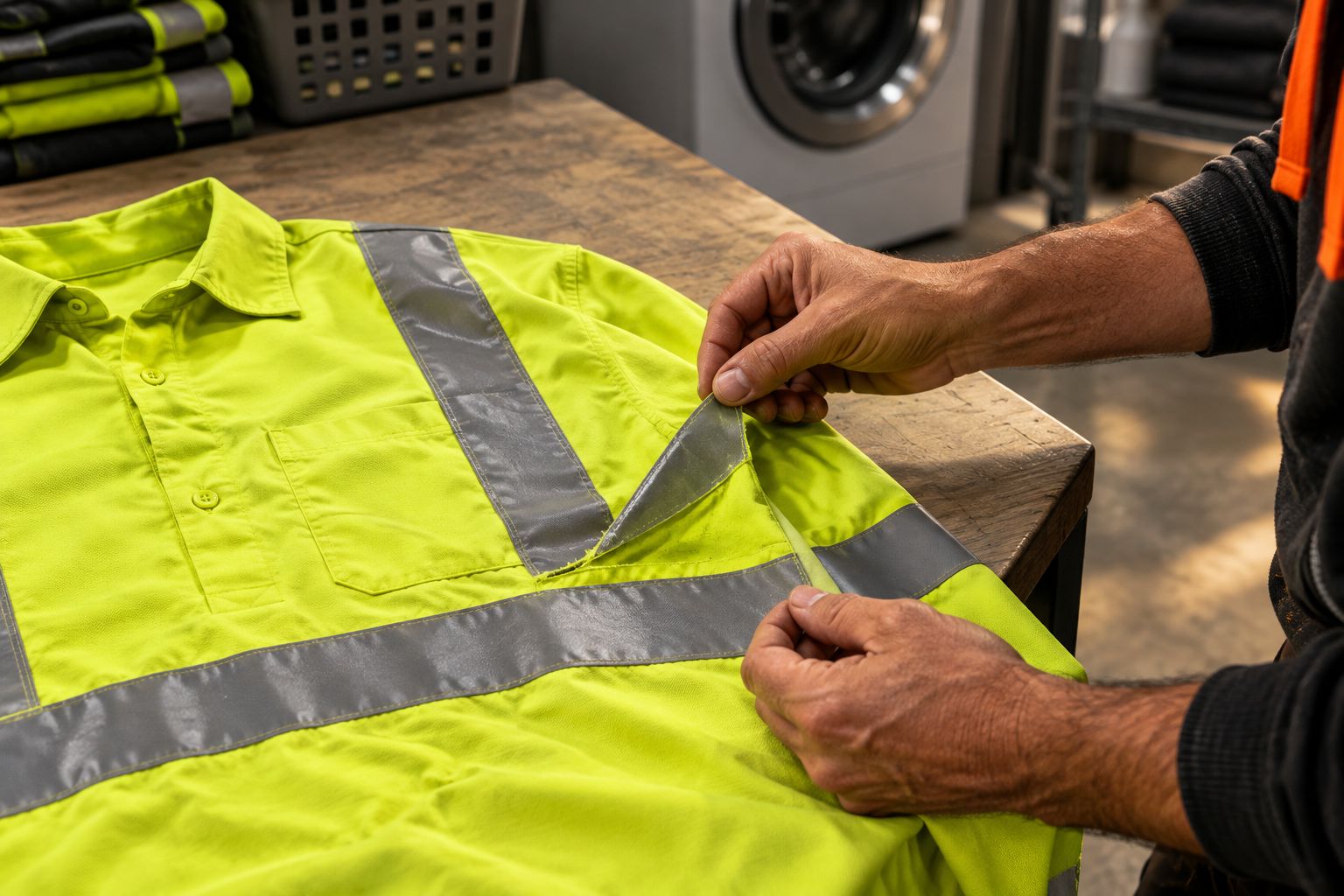
A visual check identifies obvious problems; it does not measure retroreflective performance or certify compliance. A phone torch photograph is not a compliance test either, so refer uncertain garments to the person responsible for workplace protective clothing.
Do not return questionable hi-vis clothing to a task that requires it while waiting for a replacement decision. Follow your workplace process for approved replacement clothing.
Can you use an industrial laundry for hi-vis?
Use an industrial laundry only when the exact garment is approved for that process. A product described as tolerating domestic washes does not establish suitability for industrial temperatures, chemicals, mechanical action or finishing.
For a 2026 laundry contract, give the provider the garment model and manufacturer’s instructions before committing to a uniform range. Ask the provider to confirm process compatibility and explain how garments needing repair or replacement are separated from the return load.
The benefit is a defined cleaning and inspection arrangement. The limitation is compatibility: do not select a shirt first and assume the laundry can safely process it afterwards.
Can embroidered or printed hi-vis workwear be washed?
Embroidered and printed hi-vis workwear can be washed according to the instructions for the finished garment. The decoration method, garment fabric and reflective components all need compatible care.
Before placing a branded order, give the supplier your required cleaning process and workplace specifications. Ask for the proposed logo position to be checked against the exact garment’s requirements; a digital proof shows placement, not a test of ongoing safety performance.
Workwear Martaustralia offers decorated orders from 5 garments and a free digital design proof before production. Request an itemised quote separating garments, decoration, setup, delivery and GST, and confirm the care instructions before approval.
When should you replace washed hi-vis clothing?
Replace hi-vis clothing when it reaches the manufacturer’s stated service limit or no longer meets the condition and requirements for its task. Whichever happens first controls the decision.
A 2026 replacement plan should cover both routine wear and garments withdrawn unexpectedly. Keep the exact approved model and required specification in your purchasing records so a replacement is not chosen by colour alone.
Do not cover damaged reflective tape with a logo patch or make an improvised repair. Obtain manufacturer-approved advice about repair or replacement, particularly where alterations affect the garment’s required design.
FAQ
Can hi vis be washed in a normal washing machine?
Yes, if the exact garment’s care label permits machine washing. Follow its temperature, cycle, laundry-product and drying instructions, and inspect the garment before reuse.
How many times can hi-vis clothing be washed?
50 domestic washes is the reflective-tape claim in the supplied descriptions for JB’s 150 gsm and 190 gsm shirts, not a universal hi-vis lifespan. Follow the exact garment’s instructions and withdraw it earlier if its condition requires replacement.
Can I tumble dry my hi-vis shirt?
Tumble dry a hi-vis shirt only if its care instructions permit it. Check the permitted setting and any separate restrictions for reflective tape or decoration.
Can I use bleach or fabric softener on hi-vis workwear?
Use bleach or fabric softener only where the garment manufacturer’s instructions permit it. Check stain-treatment products as well rather than assuming normal household laundry products are compatible.
Does reflective tape mean my washed shirt is still compliant?
Reflective tape alone does not establish that a washed shirt remains compliant. The garment’s condition, required class, design, manufacturer’s instructions and workplace requirements all matter.
Can embroidered hi-vis go through an industrial laundry?
Embroidered hi-vis can go through an industrial laundry only when the finished garment is suitable for that process. Confirm compatibility for the base garment, reflective components and embroidery before placing the order.
Should I replace hi-vis before its maximum wash count?
Yes, replace hi-vis before its maximum wash count if damage, fading, contamination or other deterioration makes it unsuitable. A wash limit is not permission to keep wearing a compromised garment.
One last thing
A clean garment is not automatically a serviceable garment. Put the inspection step where clothing returns to the worker, not just where it enters the wash.
Before your next order with Workwear Martaustralia, request the exact garment’s care instructions with the free digital mock-up. Checking laundry compatibility before production is more useful than discovering a conflict after your team’s uniforms are decorated.
